
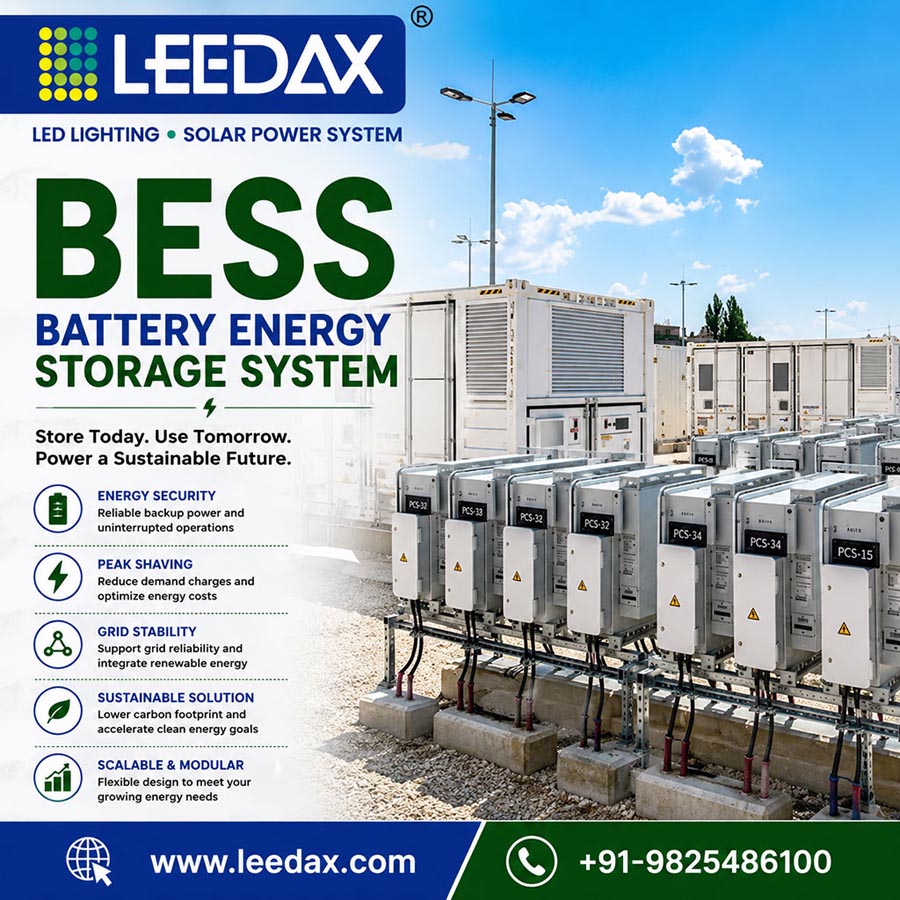
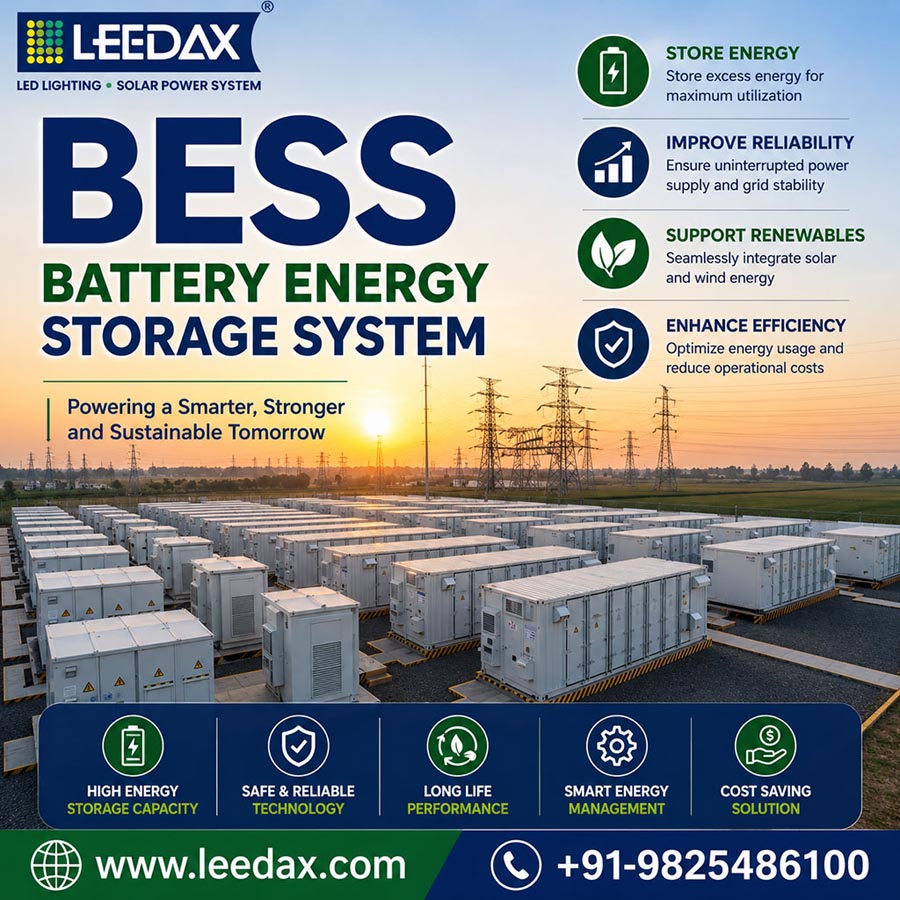
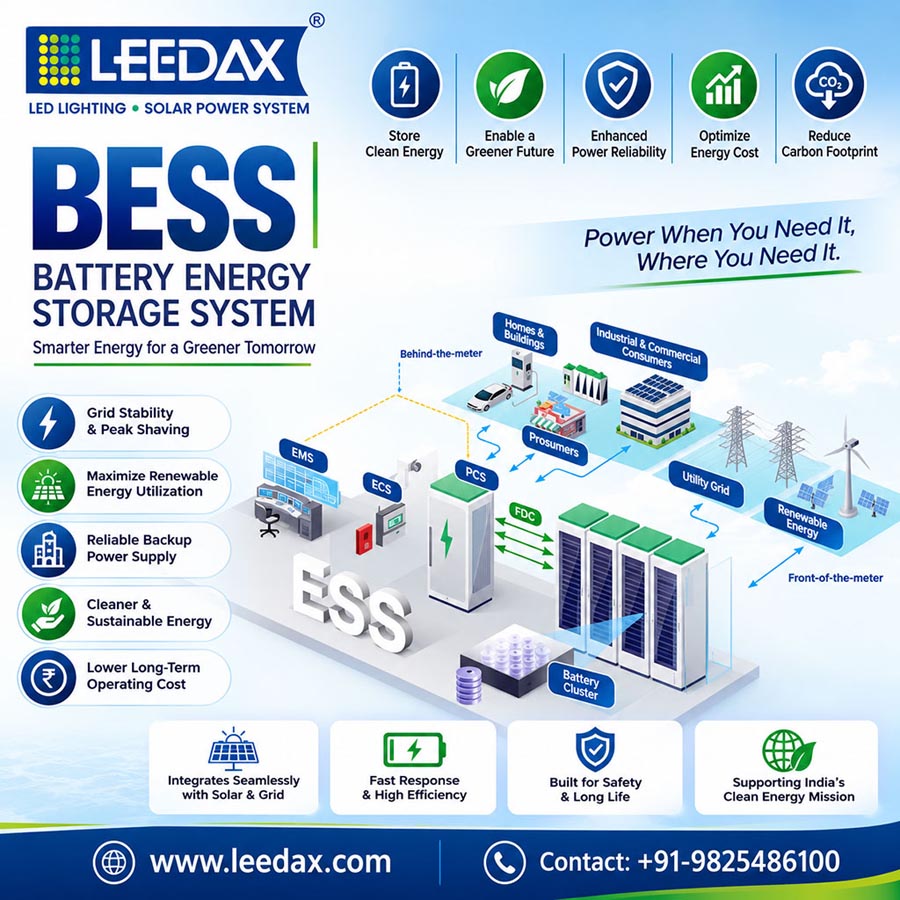
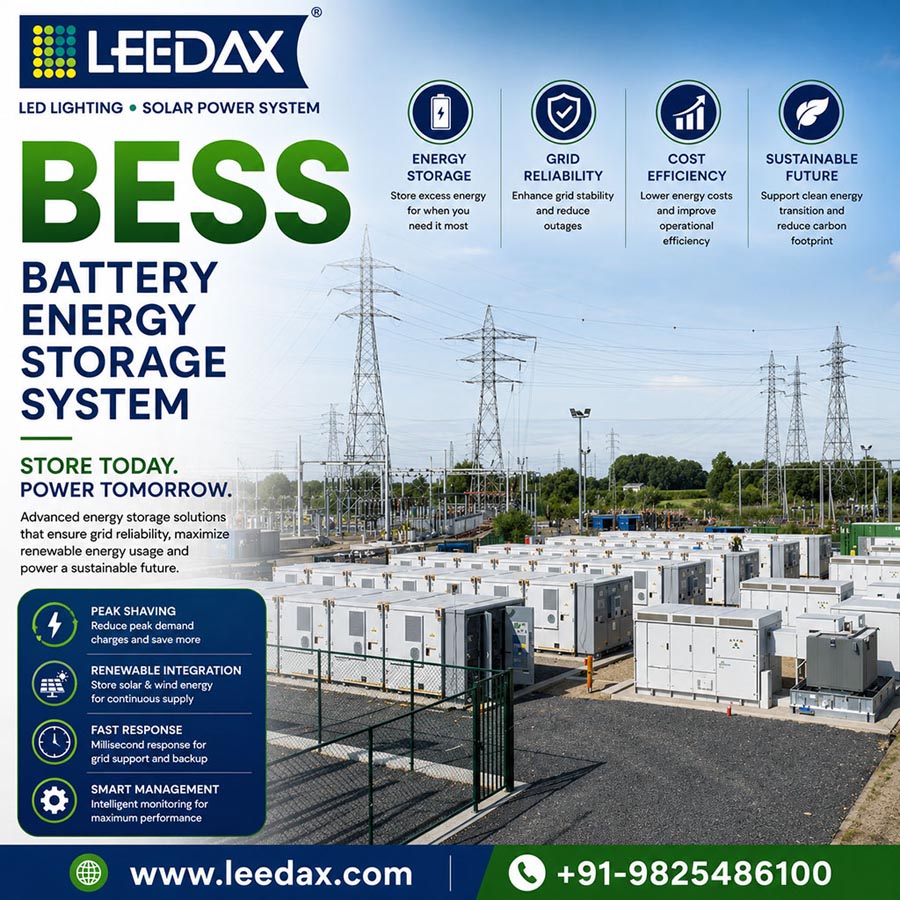
A Battery Energy Storage System (BESS) is an advanced energy-storage solution designed to store electrical energy and make it available when required. BESS technology is becoming increasingly important as industries, commercial facilities, renewable-energy projects and electricity networks adopt solar power, wind energy and other variable renewable-energy sources. By storing electricity when energy is available and supplying it when required, a Battery Energy Storage System can improve energy management, power reliability and the utilization of renewable energy.
A typical BESS system consists of battery modules, battery racks, a Battery Management System (BMS), Power Conversion System (PCS), Energy Management System (EMS), thermal management, protection equipment and associated electrical infrastructure. Lithium-ion battery technologies, including Lithium Iron Phosphate (LFP), are widely used in modern stationary energy-storage applications because of their performance characteristics and suitability for large-scale systems.
A Battery Energy Storage System for solar power plants can store excess solar electricity generated during the daytime and discharge it during periods of higher demand or lower solar generation. This enables better utilization of solar energy and can help address the intermittent nature of renewable-energy generation.
BESS solutions can be configured for different applications, ranging from commercial and industrial energy storage to utility-scale renewable-energy projects. Depending on the system design, BESS can provide peak shaving, load shifting, backup power, renewable-energy integration, energy arbitrage and other grid-support functions.
LEEDAX can provide customized Battery Energy Storage System solutions based on project capacity, load profile, renewable-energy generation, required backup duration, operating conditions and electrical infrastructure. Proper system sizing, battery technology selection, thermal management, protection, fire-safety provisions and energy-management controls are essential for safe and reliable BESS operation.
| System Type | Battery Energy Storage System (BESS) |
| Battery Technology | Lithium-ion, commonly LFP (Lithium Iron Phosphate) for stationary applications |
| System Capacity | Customized from kWh-scale to multi-MWh utility-scale systems |
| Battery Module | Multiple cells integrated into modules and battery racks |
| Battery Management System | Monitors cell voltage, temperature, state of charge and system protection parameters |
| Power Conversion System | Bidirectional PCS for charging and discharging the battery |
| Energy Management System | Controls charging, discharging and energy-flow strategies |
| Operating Mode | Grid-connected, solar-coupled, hybrid or backup configuration |
| Round-Trip Efficiency | Project and equipment dependent |
| Depth of Discharge | Based on battery technology and manufacturer’s recommended operating limits |
| Thermal Management | Air cooling or liquid cooling depending on system design |
| Safety Protection | Over-voltage, under-voltage, over-current, short-circuit and temperature protection |
| Fire Safety | Project-specific detection, suppression and safety provisions |
| Monitoring | Local and remote monitoring with BMS/EMS/SCADA integration |
| Installation Format | Indoor battery room, outdoor enclosure or containerized BESS |
| Grid Integration | Designed according to project electrical and grid-interconnection requirements |
A Battery Energy Storage System can provide significant technical, operational and economic benefits to industries, commercial facilities, renewable-energy plants and electricity infrastructure. The exact benefits depend on the project’s electricity tariff, load profile, solar generation, battery capacity, operating strategy and regulatory framework.
Peak Load Management
BESS can discharge stored electricity during periods of high electrical demand.
This can help reduce peak power requirements and improve energy-management performance where the applicable tariff structure makes peak-demand management beneficial.
Solar Energy Utilization
A solar battery storage system can store surplus solar electricity generated during periods of high solar production.
Stored energy can subsequently be used when solar generation falls, improving the utilization of renewable electricity.
Energy Time Shifting
Battery storage allows electricity to be stored during one period and used during another.
This capability can help organizations align energy consumption with operational requirements and applicable electricity tariffs.
Backup Power Support
Depending on system configuration and required capacity, BESS can provide backup or ride-through power to selected loads during grid interruptions.
Critical-load backup requires appropriate electrical architecture and system sizing.
Renewable Energy Integration
BESS can help manage the variable output of solar and other renewable-energy systems.
This can improve the controllability of renewable electricity and support greater renewable-energy utilization.
Improved Energy Management
Integration with an EMS enables automated charging and discharging according to predefined operating strategies.
Facility operators can optimize energy flows based on demand, solar generation and other parameters.
Reduced Grid Dependency
By storing electricity and supplying it when required, BESS can reduce reliance on immediate grid supply during selected operating periods.
Scalable Energy Storage
Modular BESS solutions can be designed for different capacity requirements, from commercial applications to large-scale renewable-energy projects.
Support for Sustainable Energy Goals
Battery storage combined with solar PV can help organizations increase their use of renewable electricity and develop more flexible and efficient energy infrastructure.
Battery Energy Storage Systems (BESS) can be used across commercial, industrial, renewable-energy and utility applications. Their ability to store and discharge electricity makes them particularly useful where electricity demand and renewable-energy generation do not occur at the same time.
Solar PV + Battery Energy Storage
One of the most important applications is solar battery storage.
Excess solar electricity generated during the daytime can be stored in the battery and used during evening hours, periods of low solar generation or other designated operating periods.
Commercial & Industrial Energy Storage
Factories, warehouses, offices, shopping centers and other commercial and industrial facilities can use BESS for peak-demand management, load shifting, backup support and improved renewable-energy utilization.
Peak Shaving
BESS can discharge during predefined periods of high demand to reduce peak power requirements.
This application can be particularly relevant for facilities with significant short-duration demand peaks.
Backup Power for Critical Loads
BESS can support selected critical loads such as IT systems, communication equipment, security systems, control systems, emergency infrastructure and essential industrial processes, subject to appropriate system design.
Renewable Energy Projects
Large-scale solar and renewable-energy plants can incorporate BESS to store electricity, manage renewable generation profiles and support grid-integration requirements.
Microgrids
BESS is an important component of modern microgrid energy storage systems.
It can work alongside solar PV, generators and grid connections to manage energy supply and demand within the microgrid.
EV Charging Infrastructure
Battery storage can be integrated with EV charging stations to manage charging demand and reduce sudden electrical loads on the grid.
Solar PV and BESS can also be combined with EV charging infrastructure.
Data Centers & Critical Infrastructure
BESS can provide energy-storage and backup-support functions for facilities where electrical continuity is important.
The system configuration should be designed around the required critical-load capacity and backup duration.
Utility-Scale Battery Storage
Large utility-scale BESS projects can be used for renewable-energy integration, grid-support functions, energy shifting and other applications permitted by the applicable electricity-market and regulatory framework.
Airports, Railway Stations & Transportation Facilities
BESS can support energy management, renewable-energy integration and selected backup applications at airports, railway stations, metro facilities, bus terminals and other transportation infrastructure.
LEEDAX Lighting Technologies is an R&D-driven manufacturer and solutions provider specializing in Manufacturing and Exporting of LED Lighting Solutions, Solar Lighting Systems and Solar Power EPC Solutions.
Copyright © 2026 Leedax. All rights reserved.
Website Designed & Developed by Opti Matrix